Struggles with boundary discovery
How some people struggle to calibrate depth, intensity, and charge in real time with other people.
🌎 How boundary discovery usually plays out in society?
Boundary discovery already happens in society today. It's just carried out in a very simplified and low-conscious way.
Here's how it usually manifests:
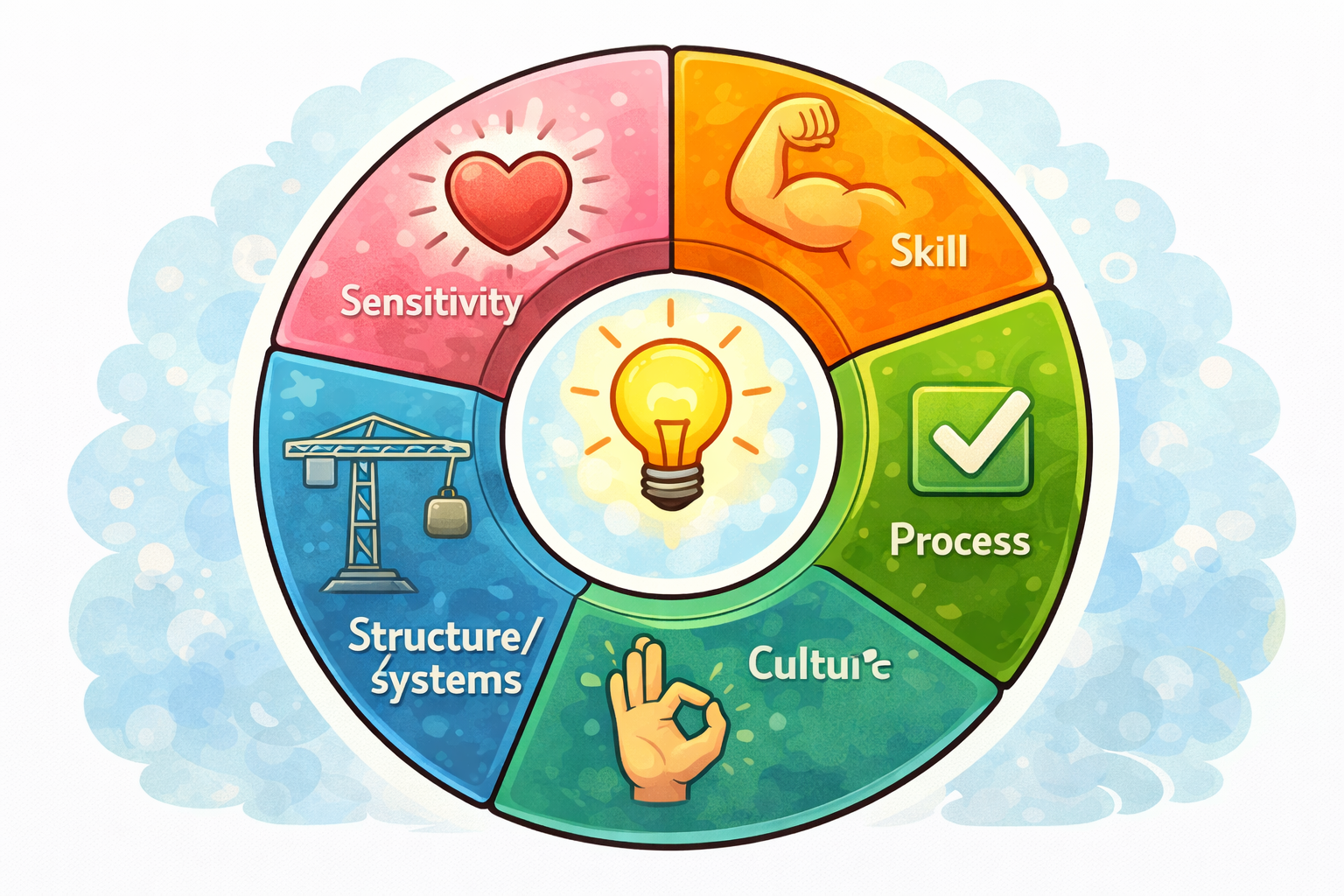
💗 Sensitivity
People notice boundaries late.
Signals are picked up only when they become obvious—withdrawal, tension, shutdown—rather than at the early, subtle edge where adjustment is still easy.
💪 Skill
Boundary handling is treated as intuition or personality, not a learnable skill.
People either push through or abruptly retreat, with little ability to modulate depth or intensity in between.
✅ Process
There is no explicit process.
Boundary discovery happens through trial and error, usually after something has already gone wrong.
👌 Culture
Culture expects people to “read the room” while discouraging meta-conversation.
Naming limits is often seen as awkward, sensitive, or disruptive rather than skillful.
🏗️ Structure / systems
Most systems reward performance, confidence, and endurance—not calibration.
They provide few tools, signals, or pauses that would support early boundary discovery.
The pattern
Across all dimensions, boundaries are:
- implicit, not explicit
- discovered late, not early
- experienced as failure, not learning
Instead of being treated as a shared, ongoing discovery process, boundaries are treated as something you’re supposed to already know—and get right on the first try.