Struggles with boundary discovery
How some people struggle to calibrate depth, intensity, and charge in real time with other people.
✅ How does society solve for the problem?
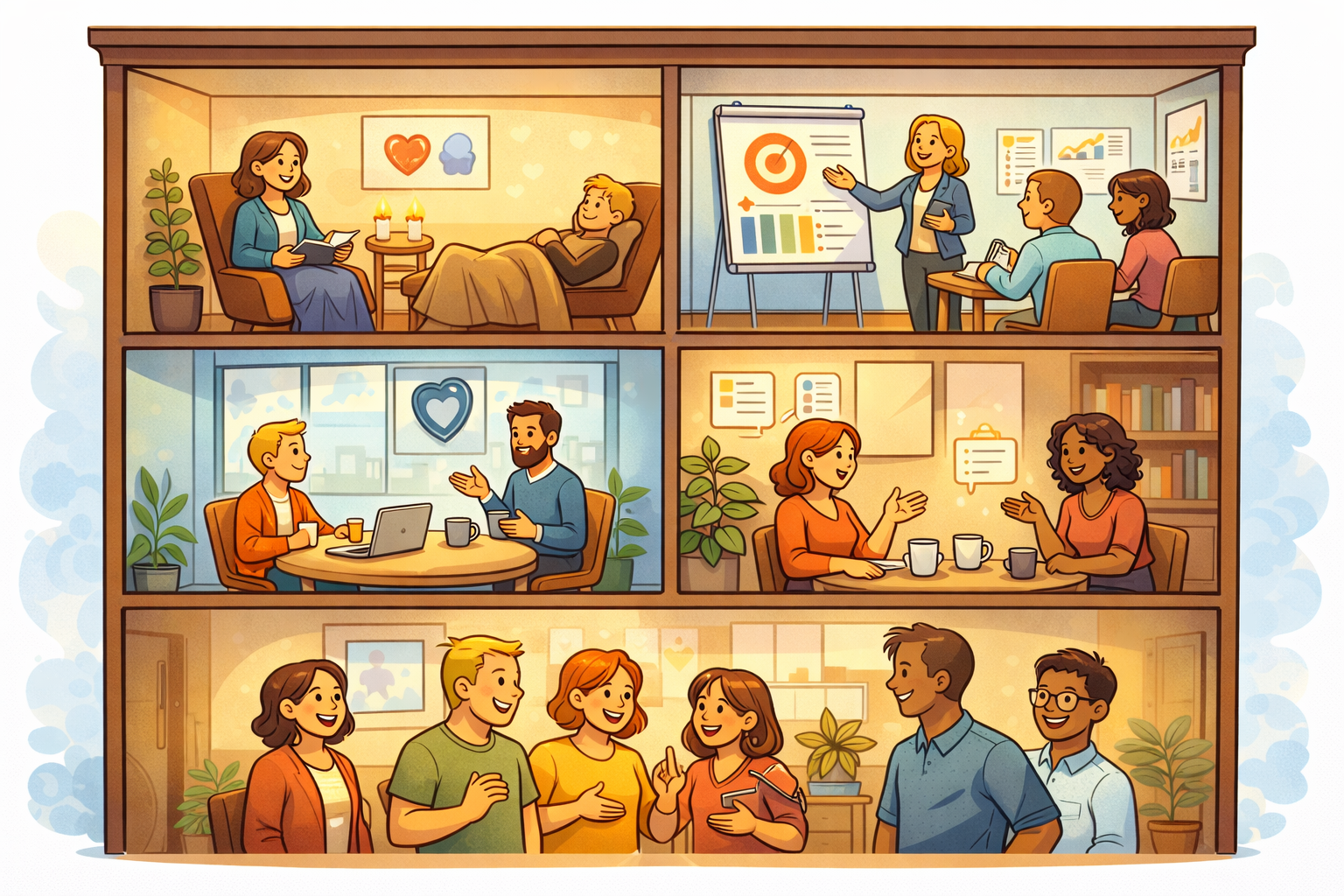
There are multiple partial attempts to handle boundary discovery in our society — each addressing a surface symptom of the problem, but not the underlying dynamic.
❤️🩹 Therapy & trauma-informed practices
These focus on safety, pacing, and consent, and come closest to the core issue.
However, they often:
- assume a clinical container
- rely on expert-led calibration
- don’t generalize well to everyday interactions
They treat boundary discovery as specialized, not universal.
🎯 Coaching & facilitation
These emphasize process awareness, reflection, and intentional pacing.
They help people talk about interaction, but often:
- prioritize outcomes or growth
- subtly reward pushing through discomfort
They frame boundary discovery as a performance skill, not a nervous-system constraint.
💙 Psychological safety (work & teams)
This attempts to make environments feel safe enough to speak up.
In practice, it:
- focuses on permission, not capacity
- assumes people can articulate limits when needed
It addresses fear of punishment, not overload or miscalibration.
👌 Consent cultures (expanded sense)
These excel at explicit signaling, graded consent, and stopping mechanisms.
But they are:
- domain-specific (mostly sexual or niche contexts)
- rarely applied to ideas, emotions, or meaning
They solve whether something is allowed, not how much is metabolizable.
🤗 Everyday social norms
Here, boundary discovery is mostly:
- implicit
- reactive
- learned through rupture
People are expected to “read the room” without shared tools, language, or structure.
🚧 The common limitation
All these approaches treat boundaries as:
- rules to set
- lines to respect
- or permissions to grant
Very few treat boundaries as what they actually are:
Dynamic limits of nervous-system capacity that must be discovered together, in real time.
As a result, society keeps solving around the problem —without naming, modeling, or normalizing the core process of boundary discovery itself.